


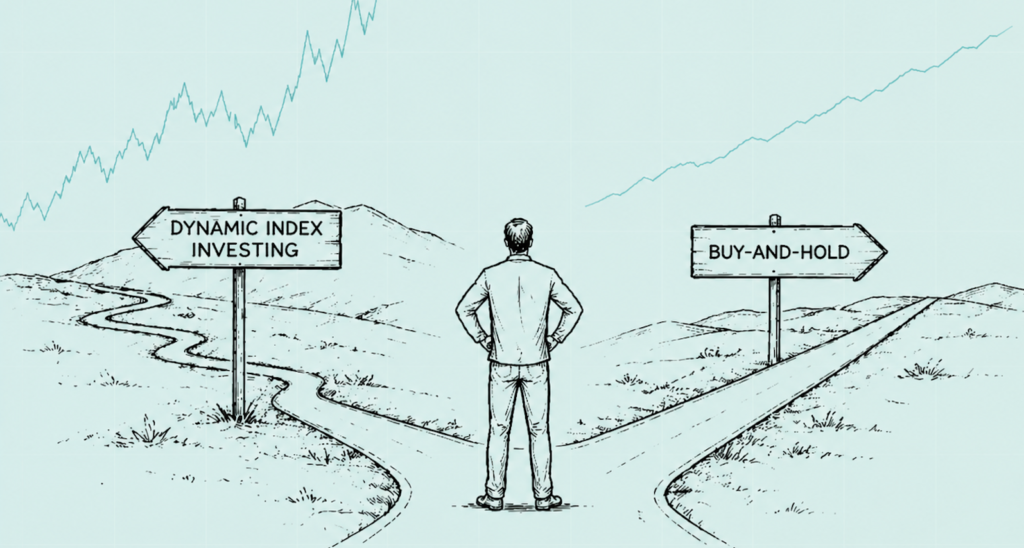
Index investing has a simple appeal. Buy the market, hold it, and let time do the work. No fund manager to evaluate, no stock to research, no rebalancing call to agonise over. It is low cost, broadly diversified, and requires almost no decisions after the initial one.
But that last part — requires almost no decisions — is also its limitation. When you invest in a broad index like the NIFTY 500, you are effectively holding large, mid, and small caps in fixed proportions. The index doesn’t adjust when one segment is meaningfully cheaper than another. It owns everything, at whatever price it happens to be trading. In doing so, it assumes that the relative attractiveness of these segments does not change in any meaningful way.
In reality, it does.
There are phases where small caps become excessively expensive. Phases where large caps are relatively cheap. Sometimes the divergence is modest. Often it is not. And these differences often persist far longer than most investors expect. Yet, a buy-and-hold approach ignores all of this. It continues allocating capital in the same proportions, regardless of valuation.
That raises a simple question. Can a small, rule-based change to how we allocate across the market improve outcomes, without ever leaving the index universe?
A simple idea
The approach here is deliberately simple. Stay fully within indices, but don’t keep the allocation static.
Each month, we look at the valuation of three segments of the market: large caps, mid caps, and small caps. Allocation is then adjusted based on relative valuation, using a straightforward rule. The lower the P/E of a segment, the higher the allocation to it. The higher the P/E, the lower the allocation.
There are no forecasts involved. No qualitative overlays. Just one signal, applied consistently.
In effect, this is a way of introducing a mild valuation tilt into an otherwise passive framework.
How it works
At the start of every month, we look at the median P/E of three index segments — NIFTY100, NIFTYMIDCAP150, and NIFTYSMALLCAP250. For each, we compute the inverse P/E, or earnings yield, and then normalise these so they sum to 100%. That becomes the target allocation for the month.
The portfolio is then rebalanced to these weights at the closing price of the first trading day of the month. Overweight segments are trimmed, underweight ones are added to, and any gains are taxed using a FIFO approach.
And that’s it.
The portfolio is always fully invested in equities. It never raises cash, never calls a top, and never tries to time anything. It simply asks, every month: which part of the index is cheaper right now, and allocates accordingly.
What the Data Suggests
To avoid relying on a single start date, a new portfolio is started every month from January 2018 to March 2025. Each begins with ₹100, follows the same allocation rule, and is rebalanced monthly. All portfolios are then tracked until March 2026 and are benchmarked against the NIFTY 500, held without any changes over the same period.
The reported values are pre-liquidation. Since the dynamic strategy triggers periodic rebalancing, taxes are paid along the way. In contrast, the buy-and-hold benchmark defers taxes entirely, which would result in a higher tax outgo if liquidated at the end, resulting in lower returns.
The bottom Line
The Bottom Line
The results of this experiment suggest that “doing nothing” is not an optimal strategy, but a missed opportunity. Even a simple, rules-based approach to allocation can improve outcomes relative to a static buy-and-hold. Not dramatically, and not in every period, but often enough to be meaningful.
This is a very simplified model. It captures one dimension of decision-making — allocation across segments. It does not attempt to pick better businesses, avoid structural risks, or incorporate multiple factors. What it does show is that even in a passive world, a little bit of management goes a long way.
So the question is no longer whether active decisions add value, but how much value a more robust approach can create. Because as the data shows, even a small, systematic step in that direction can meaningfully shift outcomes.
